
Bedford County Release Dates Explained
A date shown in a docket or corrections record must be labeled by what it means. The legal authorization may be a bail order, sentence, Parole Board action, or amended court order. The physical release is the point when the jail or prison ends custody. A locator or PA SAVIN update is the time a public system posts the event. These timestamps can differ without any record being wrong.
A projected or scheduled date is an estimate based on the sentence and current facts. An actual release date records an event that has happened. A minimum sentence date is generally the earliest point when ordinary Pennsylvania parole may be considered. It is not a promise. A maximum date is the calculated end of the judicial sentence, subject to lawful credit, recalculation, consecutive terms, or recommitment.
Pretrial custody is different. A person awaiting trial may leave after bail, a court order, disposition, or another legal event, but there may be no fixed date in advance. Another detainer can keep the person confined even after bail is posted. For BCCF custody, the jail record is the best source for the real door-out or transfer time.
Find Bedford County Projected Release Dates
First determine whether the person is at Bedford County Correctional Facility, in a Pennsylvania state institution, under another county, or in federal or immigration custody. The systems do not share one master release-date field. BCCF handles its own physical-custody record. Pennsylvania DOC calculates state minimum and maximum dates. A Bedford court docket supplies orders and sentence terms, while the Parole Board supplies its own decision document.
- Confirm the person with full name, date of birth, docket number, and inmate or parole number when known. A matching name alone is not enough.
- For a BCCF detainee or county sentence, read the UJS case docket and sentencing order. Then contact BCCF at (814) 623-2955 for current custody and the actual release or transfer record.
- For a state sentence, search both modes of the PA DOC locator. Record the exact status, location, minimum, maximum, release, and last-update wording that appears.
- Obtain the person-specific Board Action when parole was considered. A grant, refusal, deferred action, or parole to detainer changes how a date should be read.
- For formal proof or a fully discharged person who no longer appears, request the existing record from Bedford County or PA DOC instead of estimating from an old public result.
The Bedford County release search and record path gives the broader sequence for county, state, federal, and immigration custody. Use that route when the responsible custodian is uncertain.
Note: A person who leaves BCCF for DOC, another county, BOP, or ICE has transferred custody rather than gained community release.
Pennsylvania Locator Date Limits
The Pennsylvania public locator has no field literally labeled “Projected Release Date” or “Tentative Release Date.” That negative result is important. The Inmate Locator covers people currently under DOC jurisdiction, while the Department Supervised Individual Locator covers people currently under DOC supervision. The parole-side record may show a field labeled “Release Date,” but that label should not be rewritten as final discharge or a future projection.
Search fields include first, middle, and last name; inmate number; parole number; gender; committing county; location; citizenship; and birth date or approximate age. Results can include name, identifiers, current and permanent location, committing county, a photo, physical descriptors, sentence information, parole data, and an update time. Availability varies. Start with a unique DOC or parole number when possible.
| Public field or mode | What it can establish | What it cannot establish |
|---|---|---|
| Inmate Locator | Current DOC jurisdiction or placement | A future promised release day |
| Supervised Individual Locator | Current state field supervision and available release data | Final discharge from every obligation |
| Minimum date | Earliest ordinary parole eligibility point | Mandatory physical release |
| Maximum date | Calculated end of the judicial sentence | An unchangeable date in every circumstance |
| Release Date | A parole-mode release field where displayed | A county-jail release or a literal projected-date field |
A no-result outcome can reflect a spelling problem, the wrong search mode, a delay, or full discharge from the locator's current scope. DOC routes official inmate-record questions to RA-centechrecords@pa.gov. Its Right-to-Know service is the formal request channel for existing state records.
Bedford County Sentence Date Rules
Pennsylvania uses indeterminate sentencing concepts built around a minimum and maximum. Under 61 Pa.C.S. § 6137, the Parole Board ordinarily cannot parole a person before the judicial minimum expires. Reaching the minimum makes review possible. It does not compel the Board to grant parole and does not set the hour of release.
The Board can deny or defer release. Even after a grant, DOC may still need an approved residence, completed conditions, paperwork, and detainer review. The person's Board Action is the source for the decision and conditions. The locator shows current DOC status. Physical release should be confirmed from DOC's record rather than inferred from the decision date.
For a county term at BCCF, obtain the court's sentencing order and the facility's actual computation. Research found no Bedford-specific online good-time policy, calculator, weekend rule, or release schedule. Those gaps must remain visible. Do not import a rule from another county or treat a state DOC program as if it automatically applied to a BCCF sentence.
A Bedford County docket can show credit for time served, sentence terms, and later court orders, but it may not show the jail's final arithmetic or physical exit time. Read the chronological entries and the signed order together. If a sentence includes more than one count or case, identify whether the terms run at the same time or one after another. DOC aggregates consecutive state terms when it calculates controlling dates. BCCF should be asked for its own existing computation on a county sentence. A clerk can explain where the judicial order is filed, while corrections staff own the custody record.
That division also prevents a common error with bail and pretrial detention. A bail change supplies legal authority for release only when every condition is met and no other hold controls the person. The court event can precede the physical event. Ask BCCF whether another county, probation office, state agency, federal authority, or immigration authority lodged a detainer. If so, the event may be a transfer with a destination, not release to the community.
The official Pennsylvania parole-process source pictured below explains why minimum, maximum, and release are separate concepts. Review the Parole Process at its live source before using a saved screenshot.
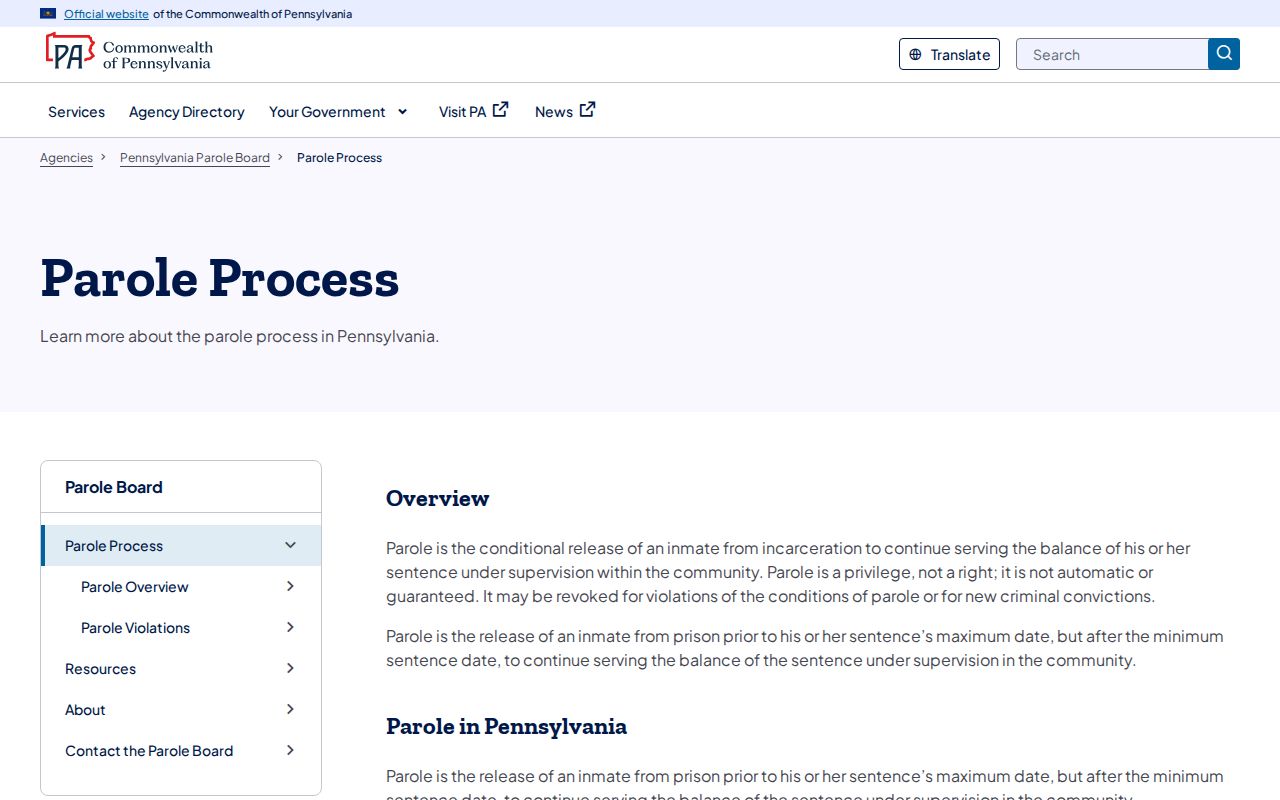
The image supports Pennsylvania's sentence-date framework, but only a person-specific court and corrections record resolves a Bedford County case.
No General 85 Percent Rule
Pennsylvania's Parole Board expressly rejects the common claim that every prisoner must serve 85 percent of a maximum sentence before parole. There is no general Pennsylvania 85 percent rule. Ordinary parole is tied to the court-fixed minimum and Board authority, not a blanket percentage borrowed from the federal system or another state.
The Recidivism Risk Reduction Incentive, known as RRRI, is narrower. Under 61 Pa.C.S. § 4505, a qualifying RRRI minimum is three-fourths of an ordinary minimum of three years or less, or five-sixths when the minimum exceeds three years. Partial days round to the nearest whole day, and consecutive sentences aggregate. Eligibility exclusions, a court finding, DOC certification, and program conditions all matter.
RRRI is not generic day-for-day good time. A reader cannot determine eligibility from the sentence length alone. Short Sentence Parole under 61 Pa.C.S. § 6137.1 also has its own eligibility, exclusion, misconduct, warrant, and detainer rules for qualifying DOC commitments. It changes process, not the judicial maximum or the need to confirm actual release.
Changes to Bedford Release Dates
A release estimate can move for reasons found in the court, DOC, Board, or another authority's record. Some changes alter the sentence calculation. Others leave the dates intact but prevent release to the street. The distinction matters when someone has passed a minimum date or received a favorable decision yet remains confined.
| Factor | Effect on the date or event | Best confirmation |
|---|---|---|
| Amended court order or sentence credit | Changes the terms DOC or BCCF must calculate | Sentencing court and corrected custody calculation |
| Consecutive sentences | Combines terms and can move controlling minimum or maximum dates | Sentencing orders and DOC computation |
| RRRI or SSP eligibility change | Changes eligibility or process only when statutory conditions apply | Court finding, DOC record, and statute |
| Board denial or deferral | Keeps the person confined after reaching eligibility | Board Action |
| Home plan or release processing | May delay physical departure after a grant | DOC status and assigned field office |
| Detainer or other jurisdiction | Can result in continued custody or transfer instead of street release | Custodian's destination record and receiving authority |
| Parole revocation or recalculation | Can change custody and sentence-date calculations | Board, DOC, and court records |
A community corrections center can remain a DOC placement. Do not call it unconditional release based on the location label. Likewise, a parole-to-detainer result means one custody event ended while another hold continued.
Confirm Bedford County Actual Release
For BCCF, call (814) 623-2955 and ask whether the named person is there now. If not, ask whether the last event was community release or transfer, plus the event date, time, type, and destination. Telephone disclosure may be limited. A precise Bedford County Right-to-Know request can seek existing admission and release-log entries, the disposition, and the receiving agency.
For state custody, compare the DOC locator with the Board Action and request the DOC record if formal proof is needed. PA SAVIN can add a timestamped release, transfer, or movement event, but it is not a certified discharge record. The Bedford County VINELink Inmate Search explains how to set an alert for one person and interpret the event type.
Always preserve the exact terms. “Minimum reached,” “parole granted,” “released,” “transferred,” and “discharged” do not describe the same event. When two dates disagree, identify whether each is legal authority, sentence calculation, physical custody movement, or system update. The custodian's release log controls the door-out time, while the receiving authority controls what happened next.
Note: A release date from one system does not rule out county, state, federal, immigration, or supervision authority elsewhere.